
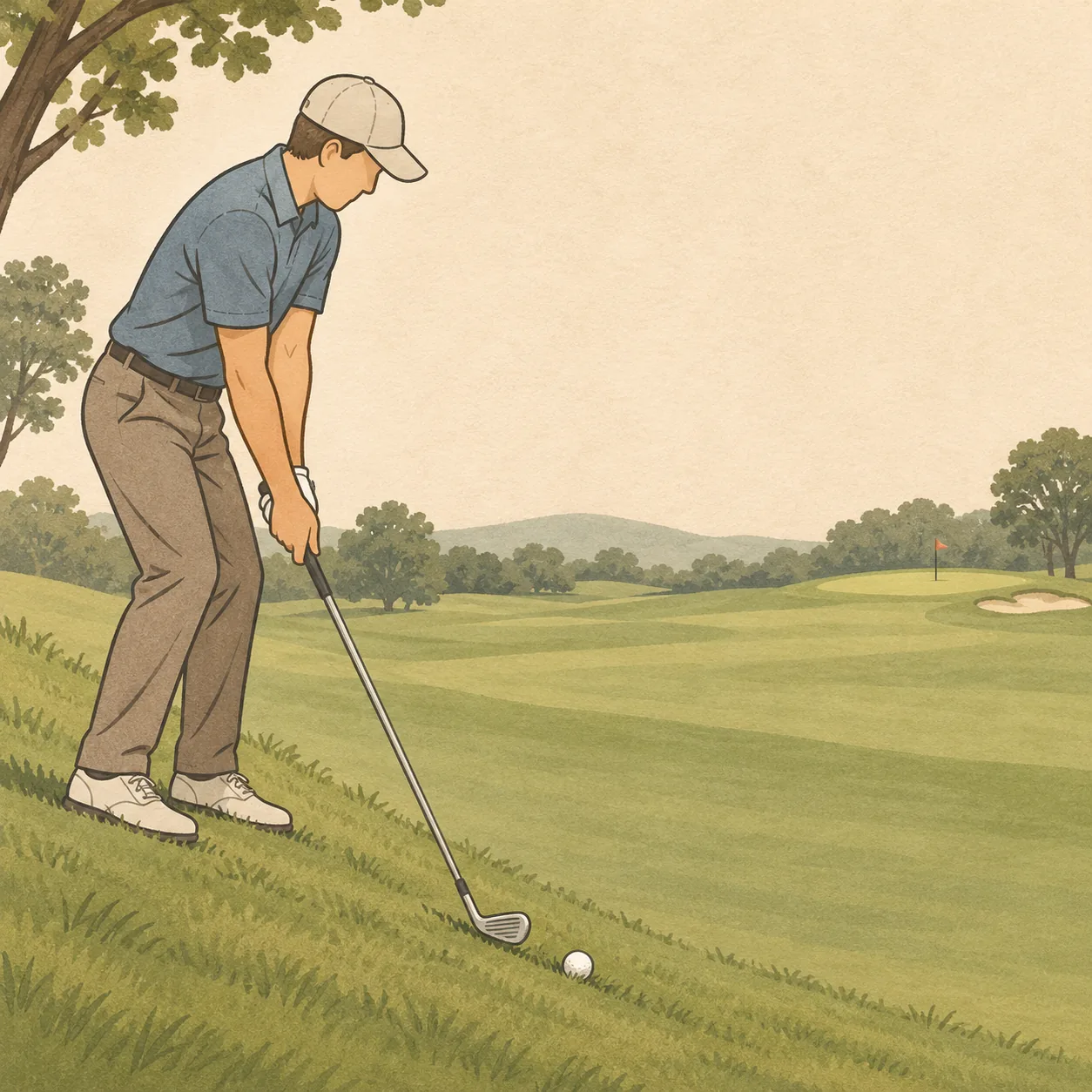
You have a familiar distance to the green and an unfamiliar place to stand. The ball sits below your feet on a sidehill. Your usual iron reaches the flag from a flat fairway, so you pull it, lean toward the ball, and try to make your normal swing.
The yardage is familiar. The shot is not. Before choosing a club, work out whether you can make a balanced stroke and where an imperfect result can finish. A ball below your feet deserves its own plan.
Identify the slope before using the distance
A ball-below-feet lie means the ground falls away from your shoes toward the ball. That differs from a downhill lie, where the ground falls along the direction you intend to hit. A real hillside can combine both. Notice which problem you are actually facing instead of reaching for a remembered instruction about “downhill shots.”
Inspect the grass around the ball as well. A clean lie on a gentle bank and a ball buried in rough on the same bank are different tasks. Your footing also matters: a stance that feels comfortable on dry turf may be unreliable on wet grass.
This is the practical gap behind the driving-range problem. A flat practice surface lets distance dominate the decision. On a slope, the quality of the contact you can reasonably expect belongs in the decision too.
Treat the expected curve as a warning, not a promise
For a right-handed golfer, a ball below the feet tends to favor a left-to-right flight. PGA Master Professional Michael Balderstone explains that the slope changes the orientation of the clubface and the way the club approaches the ball. His uneven-lie guide also notes that the amount depends on the slope and club, and that rough can interfere with the expected result.
The broad directional tendency reverses for a left-handed player. Neither version tells you exactly how far to adjust your aim. Your normal shot shape, actual contact, and the grass still matter. “Aim ten yards left” is too precise when you have never tested that lie.
Use the tendency to identify trouble. For a right-hander, a right-side penalty area should receive particular attention. Then choose a finish area with room for uncertainty. Aiming farther left is useful only if the resulting shot also has a playable route and a sensible place to land.
Find the swing you can support
Start with a stable stance and a comfortable way to reach the ball. In her PGA guidance on uneven lies, coach Sharon Fletcher emphasizes balance and suggests a slightly wider stance and a lower center of gravity for a ball below the feet. Those are starting points to explore, not measurements everyone must copy.
Make a controlled rehearsal away from the ball. Can you stay supported through the motion, or do you have to step to catch yourself? If a full swing pulls you out of balance, shorten the intended motion and reconsider the distance you are asking it to cover.
A rehearsal does not prove that the strike will be good. It can reveal that your original plan is too demanding. Do not ignore that information because the club in your hand normally goes the required yardage.
A longer club is not an automatic solution to lost distance. It still has to be manageable from the slope. Choose from shots you have practiced, and accept a shorter destination when reaching the green requires more than you can comfortably deliver.
Separate the finish area from the aiming line
The finish area is where you want the ball to end up. The aiming line is where you set up to send it, allowing for a curve you reasonably expect. Confusing the two can turn a sensible target into an unsuitable setup.
First identify an acceptable destination: perhaps the broad left-center of the green, an open approach, or a section of fairway short of trouble. Check the carry needed to get there and what lies beyond it. Only then select a starting line based on your experience with the slope.
Do not choose an aiming line through trees or another obstacle simply because you expect the ball to curve away. The intended flight needs room, and so does a shot that curves less than expected. When there is no comfortable window, change the destination.
A hypothetical approach with two different plans
Imagine a right-handed player with 150 yards to the middle of a green. The ball is below the feet on a noticeable slope. A pond guards the right side; short-left is an open approach. These distances and conditions are an invented example, not a recommendation for every 150-yard shot.
Plan A uses the normal 150-yard club and aims left, assuming the slope will provide the desired curve. It might work. But if the player has little experience from this lie, both the carry and curve remain uncertain. A target adjustment has not answered the contact question.
Plan B uses a controlled shot the player has practiced and selects the open approach as the destination. The player checks that the chosen shot can reach that area without crossing the pond and that an ordinary short result remains playable. The next stroke may be a chip rather than a putt.
Plan B is not automatically better. A player who has tested the lie and has enough room may reasonably choose the green. The useful distinction is whether the plan depends on evidence from similar shots or on the hope of reproducing a flat-fairway number.
Use nine practice balls to write a useful slope note
This is a proposed GolfRealist exercise, not a validated test. Use a designated practice area that permits shots from a gentle sidehill, with a safe landing area. If your facility offers only flat mats, ask a coach about a suitable supervised location.
Choose one familiar short or middle iron. Keep the slope mild enough that standing and swinging are comfortable.
- Three balls from level ground: use a controlled swing toward a broad finish area. Note approximate carry, direction, and quality of contact.
- Three balls below your feet: use the same club and intended effort. Observe what changes. Record a heavy or thin strike rather than replacing it with a better ball.
- Three separate decisions: step away between shots. Before each ball, choose a destination and aiming line using what you just observed. Record whether the result matched your prediction.
Afterward, write one plain sentence: “With this iron on a mild slope, my controlled shot usually finished right and short of my level-ground shots,” or whatever your actual results showed. Keep a separate note if contact was too erratic to describe a useful pattern.
Nine balls cannot establish dependable odds. Repeat the exercise on another day before trusting a tight target or forced carry. Bring recurring contact problems to a coach with the lie and your observations, rather than asking for a generic swing fix.
Take a decision to the course
When the ball is below your feet, identify the slope, check your balance, and choose a destination your practiced shot can reach. Allow for the likely curve without assuming it will rescue the plan.
You do not need to become an expert on every hillside before your next round. You need to recognize when your normal distance chart stops being enough. The useful shot is the one you can support, send through a clear route, and leave in a place you are prepared to play from.