
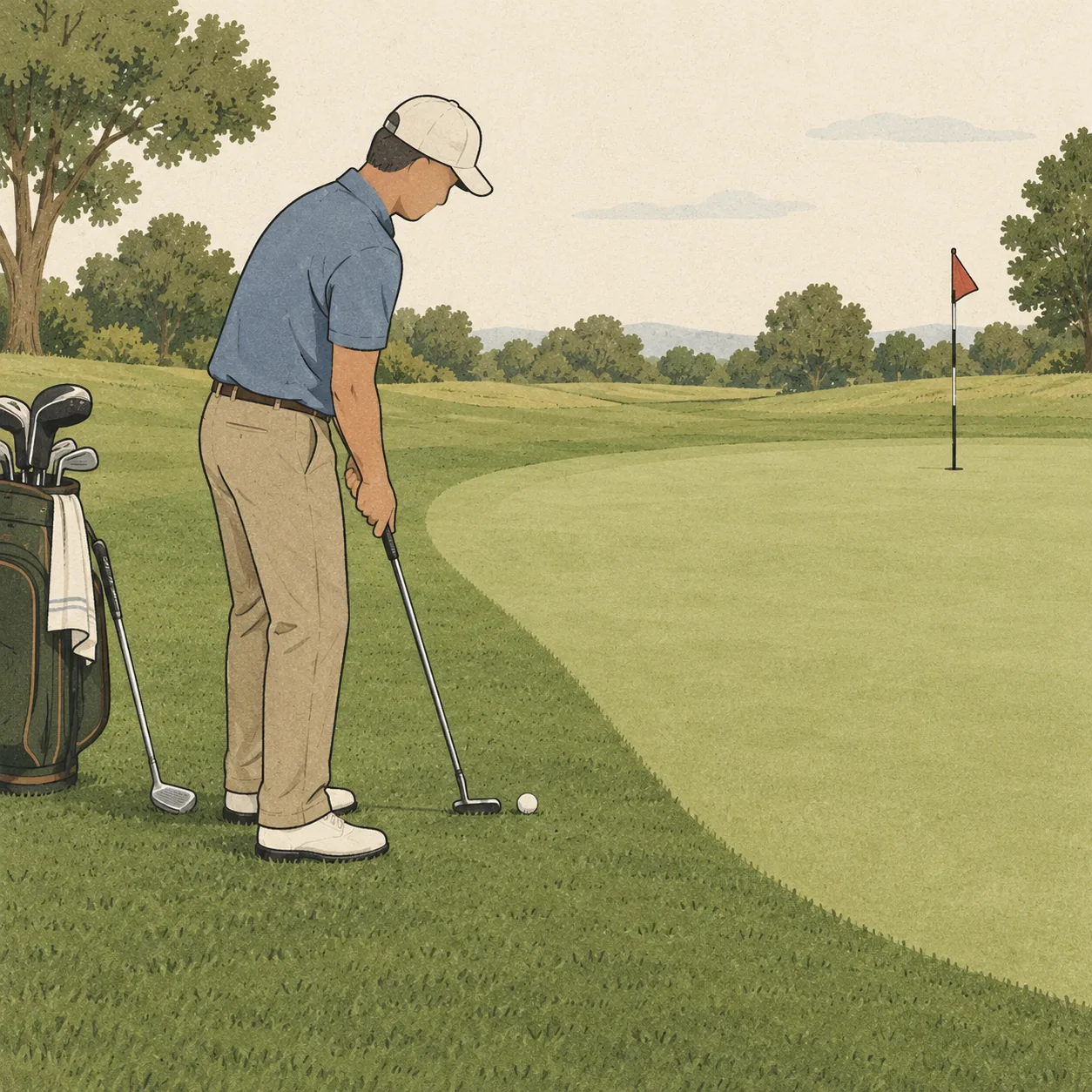
Your ball finishes two feet off the green. You reach for a wedge because that is what you use when you miss a green. Before you choose a landing spot, you have already made the most important decision.
Sometimes the putter deserves that decision. A smooth fringe and an open route can make rolling the ball a useful alternative to carrying it. But a putter is not automatically the safe club: thick grass, a sharp transition, or a demanding slope can make the ground route difficult to judge.
The useful question is specific: can you predict this ball's journey along the ground better than you can predict your normal chip?
Look at the whole route, not just the ball
Start with the lie, then look forward. A ball sitting cleanly on short grass may be easy to strike with a putter. That tells you little about the six feet it must cross before reaching the putting surface.
Look for a continuous path of closely cut, reasonably even turf. Notice thick patches, an uneven seam, a hollow, or a raised edge between fringe and green. Those features may change the first part of the roll. A short distance through awkward grass can be less inviting than a longer stretch of smooth apron.
Then read the green beyond the entry point. Where will the ball turn? Is the hole across a ridge? Does the ground beyond the hole fall away? The fringe is one part of the shot, not a separate problem you solve before worrying about the putt.
PGA coach Keith Stewart makes this broader reading point in his guidance on difficult greenside shots: the ground outside the green can influence the roll differently from the putting surface. His advice supports inspecting the full route, rather than treating every shot from the edge as straight.
Use three checks before choosing the putter
1. Can you make ordinary contact?
Can the putter meet the ball without having to force its way through a tuft? Is there room for a familiar stroke? If the ball is sitting down in rough, confidence with your putter does not remove the grass around it.
This is a decision check, not an invitation to invent a new stroke during the round. If the lie asks for a technique you have never practiced, choose a familiar alternative or a more generous target.
2. Is the roll reasonably predictable?
A clean, short-cut corridor gives the putter a case. A route through several different grass heights weakens it. So does an abrupt edge that could make the ball hop or lose speed.
There is no universal distance limit. “Always putt within five yards” ignores the surface. “Never putt from the fringe” ignores a useful option. Judge the actual route and what you have learned on similar turf.
3. What does an ordinary miss leave?
Compare a slightly weak or strong putt with your usual imperfect chip. Does the weak putt still reach the green? Would the strong one roll down a slope? Does a slightly heavy chip leave another chip?
You are comparing shots you actually produce. A wedge that works only when struck perfectly is a different proposition from a low chip you use comfortably every week. The same applies to a long fringe putt you have never tried.
Compare two versions of the same shot
Here is a hypothetical example. Your ball is three feet off the green, with roughly twenty feet of putting surface between the edge and the hole. The fringe is short and even, the transition is smooth, and the route is gently uphill. You have practiced similar putts. The putter is a sensible candidate.
Now keep the distances and move the ball into a small pocket of thicker grass. A raised lip sits directly in front of it. The hole has not moved, but your shot has changed. Rolling through that first yard is less predictable. A familiar chip that carries the awkward patch may now be the simpler choice.
Neither example proves that one club is superior. They show why distance to the flag cannot make the decision by itself. The job includes getting out of the lie, crossing the intervening ground, and leaving a manageable next stroke.
That last requirement also runs through our punch-out guide: judge the escape partly by the shot it leaves.
Learn the extra pace instead of guessing a formula
A fringe putt asks you to judge more than the green's speed. You also have to account for the intervening turf. Avoid turning that into a fixed multiplier such as adding a set number of feet for every yard of fringe. The same distance can present very different grass and slopes.
Before a round, use a designated practice area to roll a few balls from short grass onto the green, where permitted. Watch the transition. Does the ball arrive smoothly, noticeably slow down, or bounce? Compare an uphill route with a flatter one if both are available.
Use those observations as a starting point, not a promise about every collar on the course. If you have no useful feel for the surface, acknowledge that uncertainty in your club and target choice.
You can retain a familiar putting motion while adjusting for distance. Stewart's coaching guidance recommends that approach when using a putter from off the green. There is no need to manufacture a chipping action simply because your shoes are outside the putting surface.
Try this twelve-ball comparison
This is a proposed GolfRealist practice exercise, not a validated test or a guarantee of improvement. Use a short-game area where both putting and chipping are allowed.
Choose three stations: a clean fringe lie with a short crossing, a clean lie farther from the green, and a legal practice position with a mild slope or less even transition. Avoid extreme lies initially. Select a realistic hole or finish area at each station.
- At the first station, play one ball with the putter and one with your normal chipping club.
- Play a second pair, reversing the order so the same club does not always benefit from seeing the first result.
- Repeat at the other two stations. That makes twelve shots in total.
- Record each finish distance and whether the ball remained off the green or ran beyond your intended area.
Keep the misses in the record. One tap-in should not erase three shots that left difficult recoveries. Compare typical leaves and the troublesome outcomes, not only the closest ball. Twelve shots are a starting observation; repeat on another day before declaring a permanent winner.
PGA coach Brendon Elliott also recommends comparing different clubs from off the green in his short-game practice advice. The paired structure here is our own practical way to explore that choice. For broader tracking, see the GolfRealist practice scorecard.
Take one useful boundary onto the course
Finish the session with a simple personal note: “I trust the putter from clean, short fringe with a smooth entry,” or “I prefer my chip when that raised edge interrupts the roll.” Write what your shots supported, not what a perfect player might do.
On the course, check the lie, scan the route, and choose. Once the choice is made, play the shot without reopening the argument over the ball.
The putter does not need to replace your wedges. It needs a fair hearing when the ground offers a route you can use. A missed green is a location, not an automatic instruction to chip.