
There's a YouTube channel run by a former tour player, now a teaching pro, with a following so small it barely registers — a few thousand people, no viral moments, nothing flashy. What he says, though, is worth more attention than the algorithm gives him.
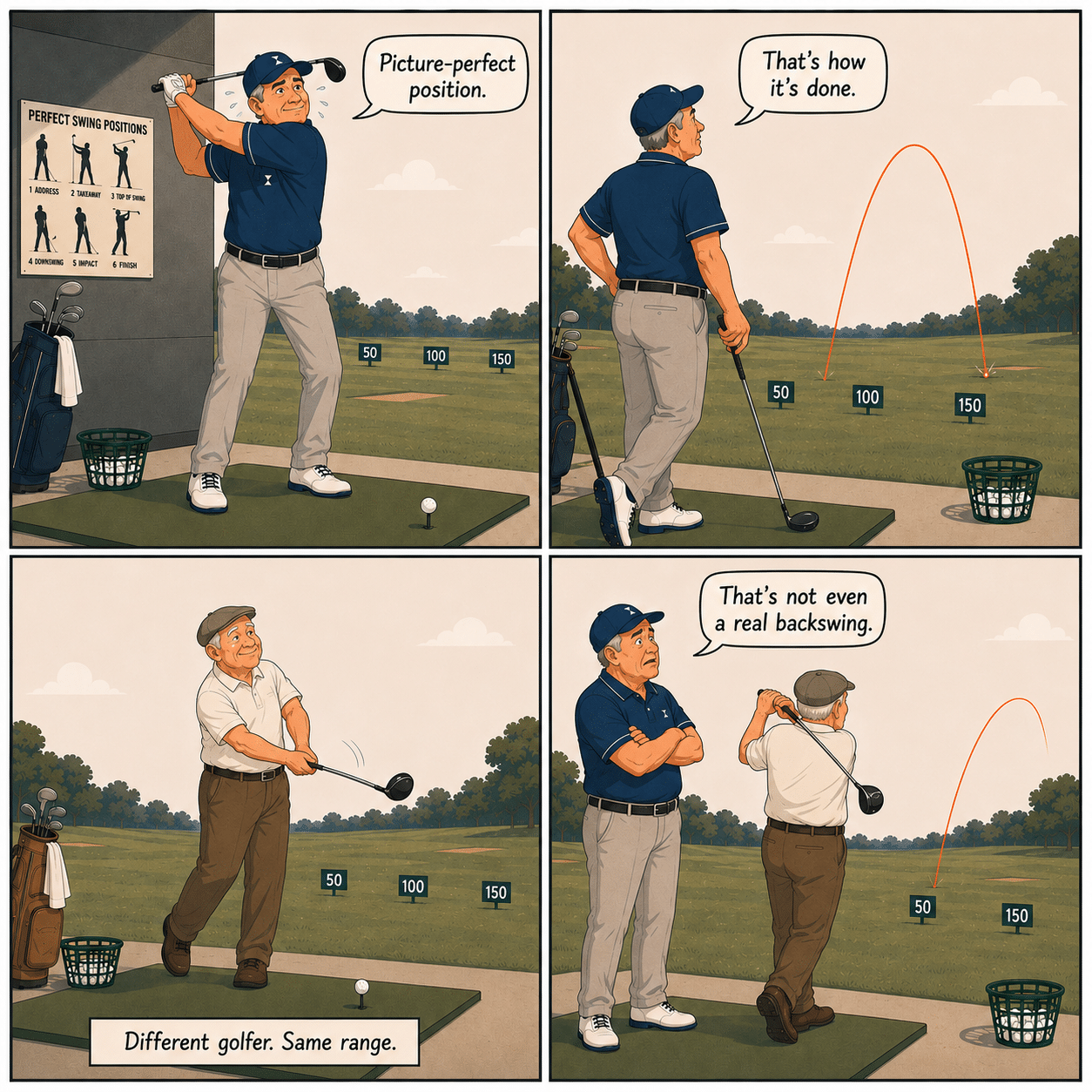
His core argument: there is no single correct golf swing. Every player who has ever swung a club well has done it with a body, a history of injuries, a range of flexibility, and a set of instincts that are entirely their own. His favorite example is Allen Doyle — a former college hockey defenseman who didn't turn pro until age 46, and who plays with a backswing barely half the length of a conventional one, more slap shot than golf swing. Tom Watson, who lost a U.S. Senior Open to Doyle, once said that watching him on the first tee, you'd think you could give him five shots and beat him easily. You'd be wrong. Doyle went on to win two U.S. Senior Opens in a row, four Champions Tour majors, and over $13 million in career earnings on the Champions Tour. Nobody ever "fixed" his swing into something more textbook. It was never broken.
To be clear, this isn't an argument against lessons. I'd genuinely recommend taking some — even just a handful a year. A stance correction here, a grip fix there, the occasional half-hour on short game. Small, targeted lessons, aimed at specific, identifiable problems, are some of the best money an amateur golfer can spend.
What concerns me is a different pattern I've watched play out over years, in golfer after golfer: the same person, same lesson, same hour, every single week, for years on end — and their scores never move. Not because the lessons are bad, but because the entire arrangement has quietly become about perfecting a swing in isolation, with no real connection to what happens four hours later on the course.
The structure of a typical recurring lesson doesn't reward variability or transfer — it rewards producing repeatable positions a camera can capture and a screen can measure, week after week, indefinitely. That's not a criticism of the people teaching. It's a description of what the environment makes convenient, and convenience quietly shapes what gets emphasized, lesson after lesson, year after year, long after the original problem has been solved.
So if you're paying for instruction — and for the occasional, targeted kind, you should — here's what's worth asking, rather than just receiving.
Ask whether your lessons include putting and short game at all, not just full swing mechanics. If every lesson you've ever taken has focused on driver and irons, you've been training the part of the game that, for most amateurs, decides the smallest share of the scorecard.
Ask whether you ever hit from a lie you didn't choose — rough, a slope, an awkward stance — instead of a flat mat every time. A lesson that never varies the lie is training a skill you'll rarely use intact on the course.
Ask what the lesson is actually optimizing for, especially if you've been taking the same weekly lesson for more than a season. "A better position at the top of your backswing" is a means, not an end. "Fewer strokes on approach shots from 100 to 150 yards" is an end. If a year of weekly lessons hasn't moved your handicap, that's worth a direct conversation, not just another booking.
And maybe most importantly: don't assume a swing flaw is automatically worth fixing just because it deviates from a textbook model. Some flaws cost you strokes. Others are simply how your particular body produces a repeatable, scoring swing — and "fixing" them risks trading a working motion for a textbook one that may never feel as natural, no matter how many hours, or how many years, you put into it.
Allen Doyle's backswing would make most golf teachers cringe, by his own admission. It also made him over $13 million and a place in the Hall of Fame. Sometimes the flaw is the swing.
Source: Allen Doyle's career earnings and swing background reported by ESPN, CBS News, and the official PGA Tour Champions player profile.