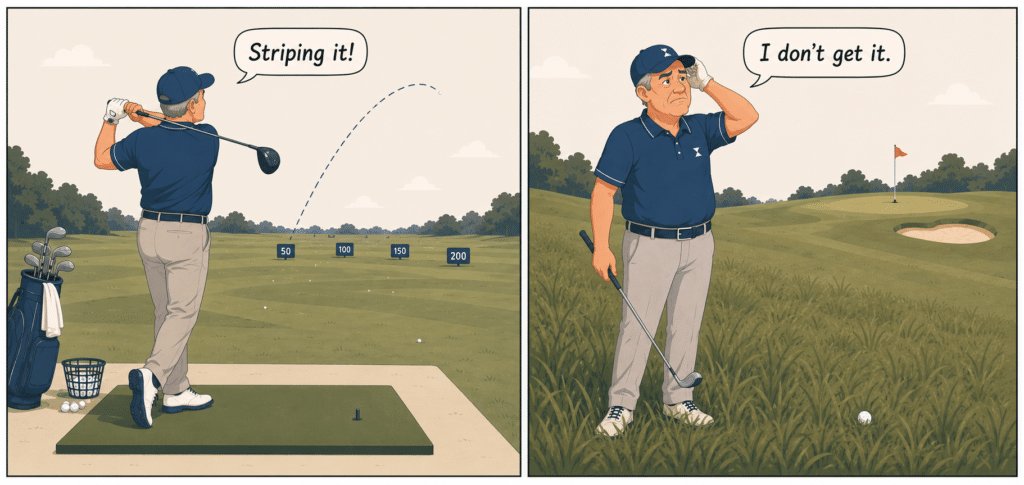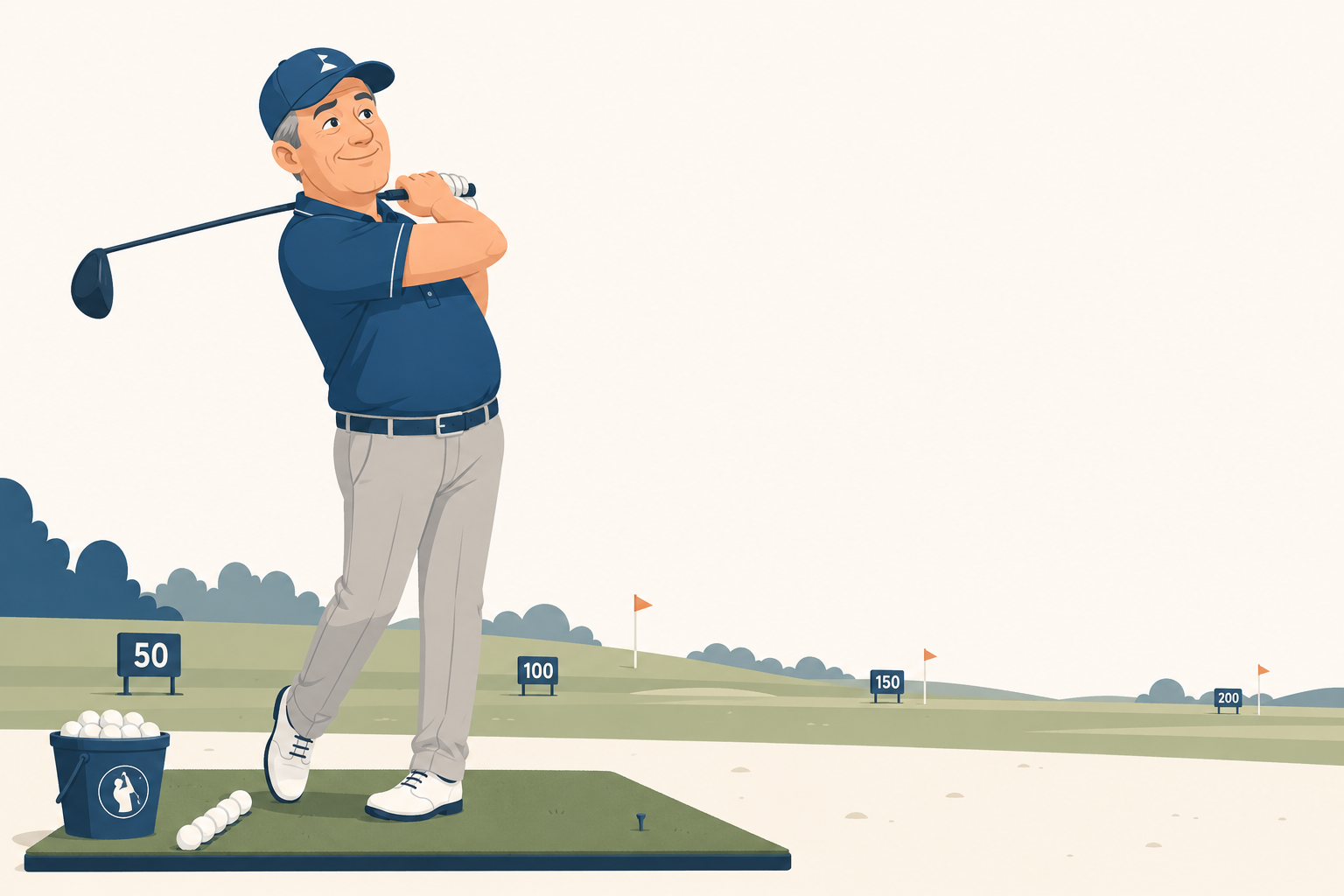
Frank hits the range like a man possessed. Eighty balls, maybe ninety. By the end of the bucket his seven-iron is pure — flush contact, a tight little draw, divots like dollar bills laid end to end. He walks off convinced this is the week it finally clicks. Four hours later he’s standing in the eighth fairway, same seven-iron in hand, and the ball sails thirty yards right into a bunker. “I don’t get it,” he says. “I was striping it on the range.”
Frank, the range wasn’t testing your golf. It was flattering it.
Here’s the uncomfortable truth most golfers never confront: the driving range and the golf course are two different games that happen to use the same clubs. The range is a laboratory built to make you feel good. The course is reality. And the gap between them is where most of your practice quietly disappears.
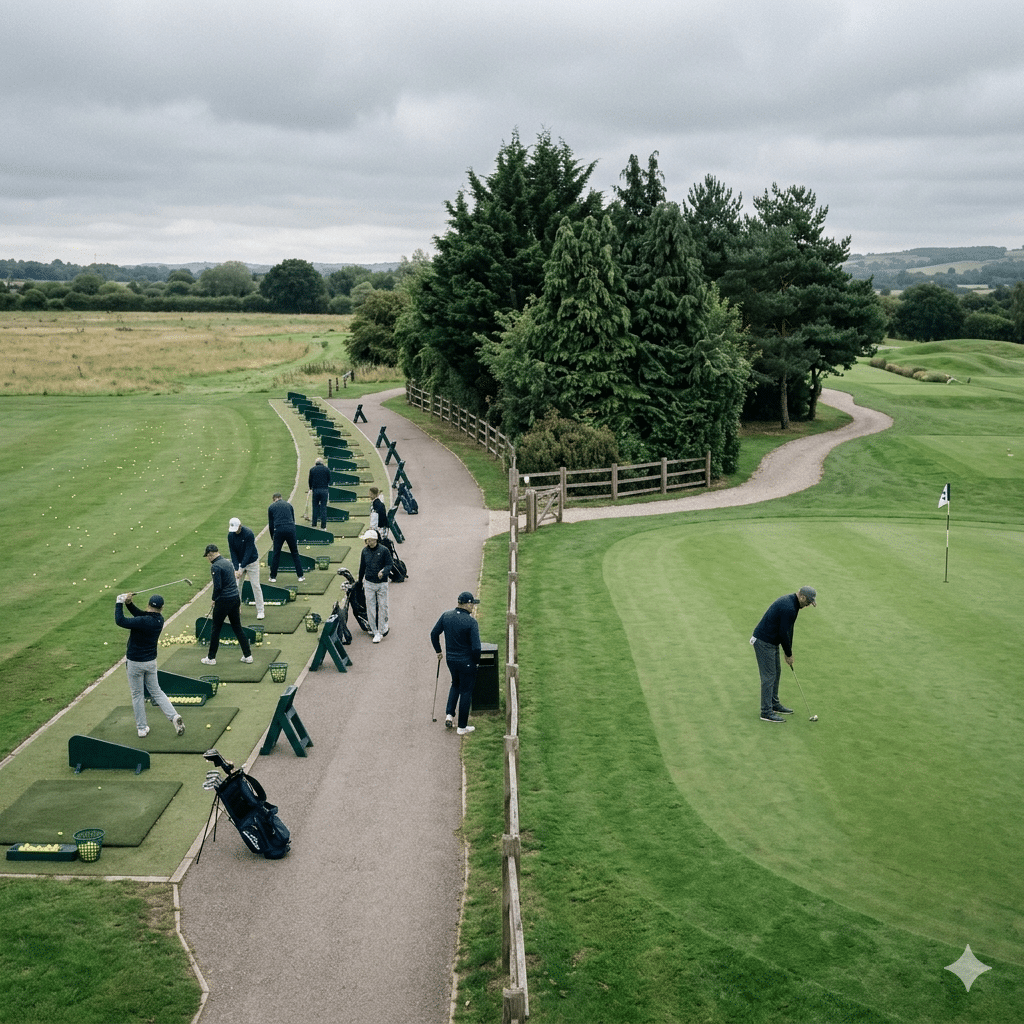
Think about what actually happens on the range. You hit from a flat, manicured lie every single time. There are no consequences — miss left, miss right, who cares, there’s another ball sitting right there. You aim at a wide-open field, not a green guarded by water and sand. And crucially, you correct as you go. Pull one left? You adjust on the next ball. Thin one? Fix it immediately. By ball number forty you’ve grooved a feel that feels like skill.
Now look at the course. Every lie is different — uphill, downhill, sidehill, rough, hardpan. You get exactly one attempt at each shot. The consequences are real: a bad one costs you a stroke, maybe two. And there’s no “next ball” to correct with. You hit, you walk, you live with it.
These are not the same skill. Repeating a motion in a consequence-free environment is a fundamentally different task than executing it once, under pressure, from an unpredictable lie, with something at stake. The range rewards repetition. The course demands adaptation. No wonder the transfer is so poor.
This is why your range sessions can look spectacular while your handicap refuses to move. You’re not lying to yourself on purpose — you’re just measuring the wrong thing. Eighty good seven-irons in a row tells you that you can groove a motion when nothing matters. It tells you almost nothing about whether you can produce one good seven-iron when it does.
There’s a deeper trap hiding in here too. Because the range feels like progress, it’s emotionally satisfying — and so we do more of it. We double down on the practice that flatters us and avoid the practice that actually transfers, because the second kind is uncomfortable, ego-bruising, and a lot less fun. Frank doesn’t keep going back to the range because it works. He goes back because it feels good.
None of this means the range is useless. It’s a fine place to work on a specific mechanical change, or to warm up. But it is a terrible place to measure your game, and an even worse place to build the one skill that actually lowers scores: hitting a passable shot, once, from a lie you didn’t choose, when it counts.
The realist’s takeaway is simple. Stop grading yourself on the range. The range is where golf feels easy. The course is where golf is true. If you want your practice to show up on Saturday, it has to start looking a lot more like Saturday — one ball, different lies, real targets, real consequences. We’ll get into exactly how to do that in future posts.
For now, just notice the next time you walk off the range feeling like a different player than the one who shows up on the first tee. That feeling isn’t progress. It’s the range doing what the range does best: telling you what you want to hear.