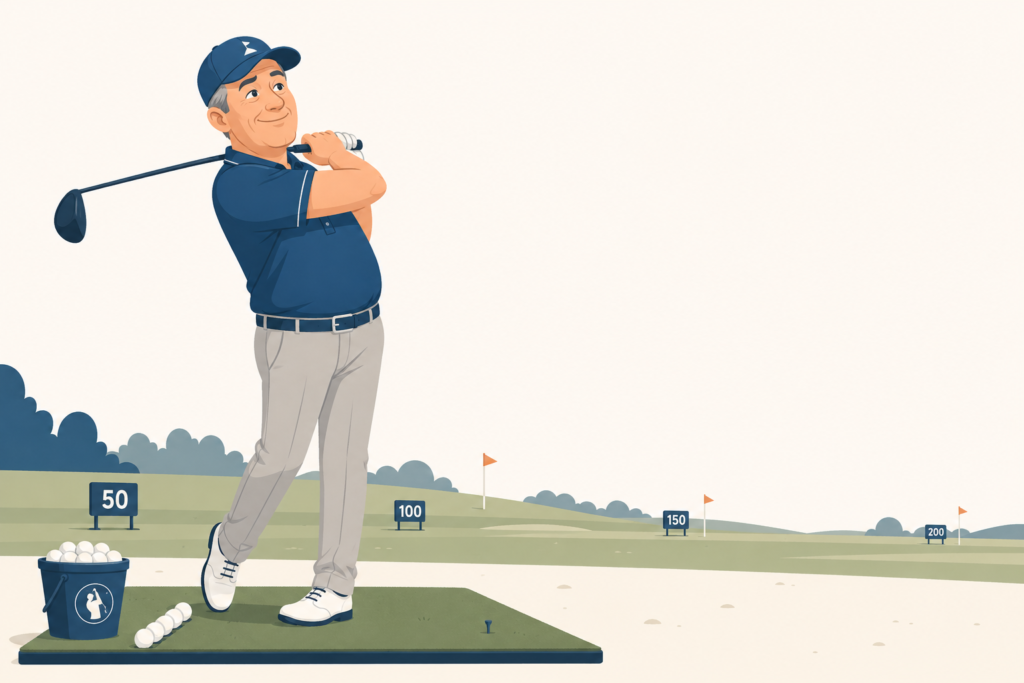
Walk onto any golf club on a Saturday morning and you’ll see it instantly. The driving range is packed — twenty people, maybe more, drivers and irons flying, a steady rhythm of contact and chatter. Walk over to the short-game area and you’ll find two, maybe three people quietly chipping. Walk past the putting green and there’s a decent chance you’ll find exactly one person out there, rolling a few putts before their tee time, already half-distracted by their phone.
Twenty. Two. One. That’s roughly how golfers allocate their practice time across the three parts of the game. Now flip it around and ask: how do those three areas actually contribute to your score?
For most golf amateurs, somewhere around 40% of all strokes happen on the green. Putting alone is often the single biggest line item on the scorecard. Short game — chips, pitches, bunker shots inside 50 yards — adds another large chunk. Full swing with the driver and long irons, the part everyone is obsessed with polishing, accounts for less of the total than most golfers assume.
So the allocation of golf practice time runs almost exactly backwards from the allocation of strokes. We spend the most time on the part of the game that matters proportionally the least, and the least time on the part that matters most. This isn’t a minor inefficiency. It’s the single biggest structural reason why so much practice fails to lower scores.
Why does this happen? A few reasons, and none of them are really about logic.
The driving range is satisfying in a way the putting green isn’t. Hitting a driver is loud, physical, visible — you can see the ball fly, feel the contact, measure the result in yards. Putting is quiet, slow, and the feedback is binary and often humbling: it goes in or it doesn’t, from two feet away, in front of anyone walking past. Practicing your weakest, most score-relevant skill is also the least fun way to spend an hour at the club. So we don’t.
There’s also a status element hiding in here that Frank would never admit to. A booming drive draws looks. A good lag putt draws nothing. Twenty people at the range isn’t just about improvement — it’s partly a performance, for an audience of other golfers doing the exact same thing.
And the club itself often reinforces the imbalance. Driving ranges are usually the biggest, most prominent facility — easy to access, well lit, well stocked with balls. Practice greens are smaller, sometimes tucked out of the way, and require you to bring your own focus rather than having a bucket of balls hand you a reason to be there.
None of this is a moral failing. It’s just an unexamined default, and unexamined defaults are exactly the kind of thing worth interrupting once you see the numbers behind them.
Here’s the uncomfortable arithmetic, simplified: if putting is roughly 40% of your score and you give it roughly 5% of your practice time, you are structurally guaranteeing that your biggest scoring lever stays undertrained. You don’t need to abandon the range. You need to stop pretending that more range time is the obvious next step, when the data says otherwise.
A simple fix, with no app or gadget required: before your next range session, spend the same amount of time on the putting green first. Not as a warm-up — as the main event. See how it feels to give your most score-relevant skill the attention the scorecard says it deserves, instead of the attention your ego says it deserves.
The twenty people at the range tomorrow morning will still be there. The green will probably still be quiet enough for you to hear yourself think.