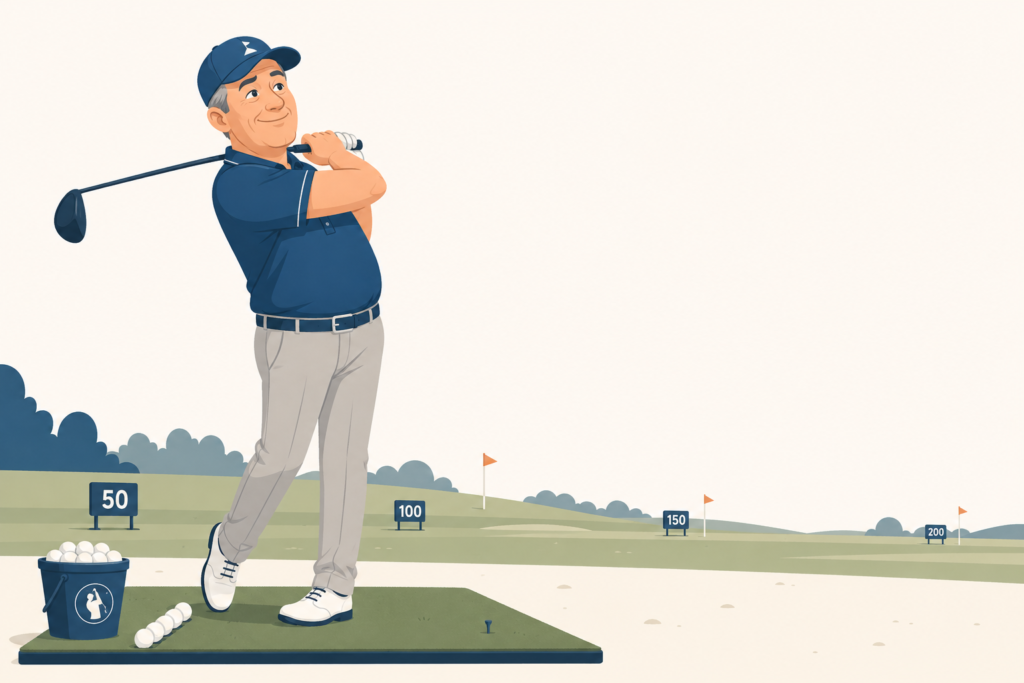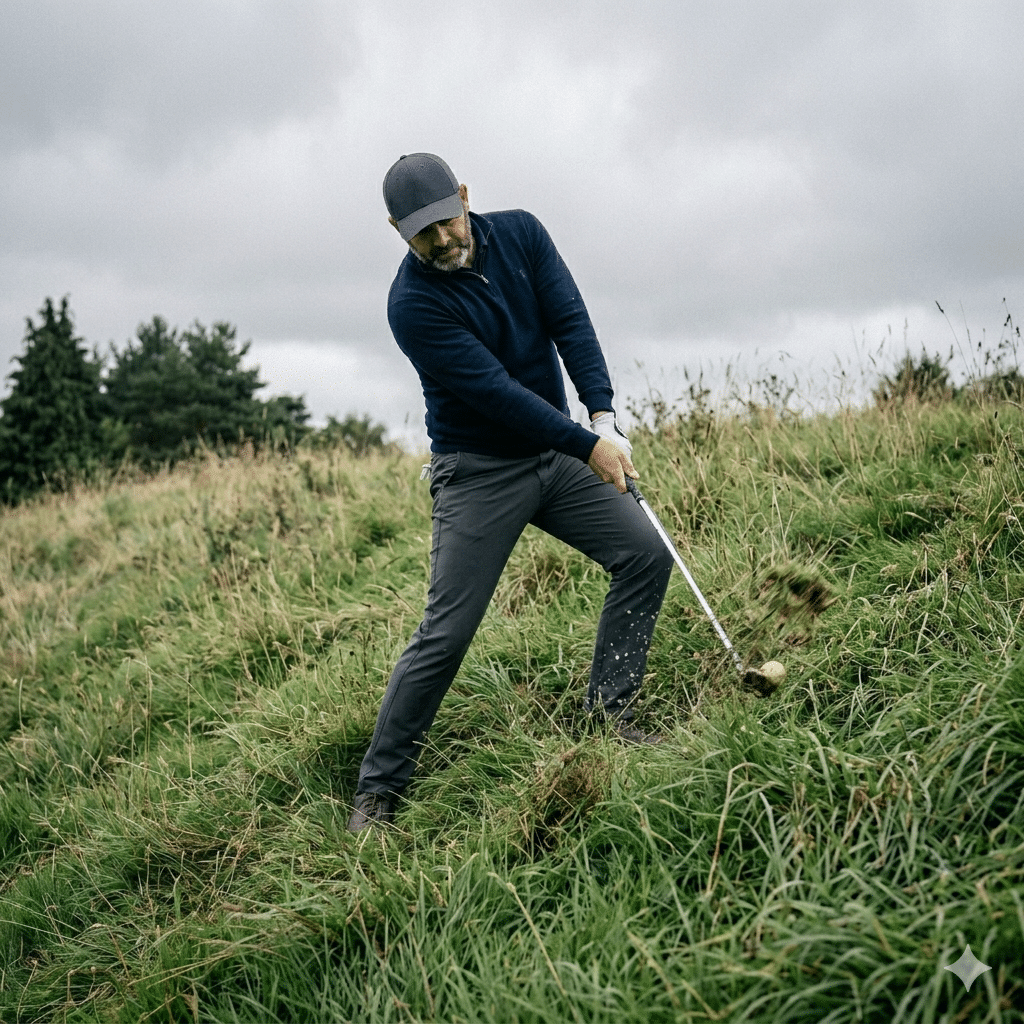
Frank has a routine on the golf driving range that he’s proud of. Seven-iron, same target, twenty golf balls in a row. Then the eight-iron, same target, twenty more. By the time he’s done, he’s hit more identical golf shots in an hour than most people hit in a month, and every group of twenty gets a little tighter, a little more consistent. “Repetition is the mother of skill,” he tells anyone who’ll listen. He read that somewhere. He’s not wrong, exactly. He’s just measuring the wrong thing.
In 1979, two researchers named Shea and Morgan ran an experiment that golf instruction has mostly ignored for the better part of fifty years. They had people practice a motor skill in two different ways. One group practiced in blocks — the same version of the task, repeated over and over, then moving to the next variation, also repeated over and over. The other group practiced the exact same total amount, but randomly mixed — never doing the same variation twice in a row.
During golf practice, the block group looked better. Fewer errors, smoother performance, faster apparent improvement. Exactly what you’d expect, and exactly what makes block practice so satisfying to do.
Then came the test that actually mattered: a delayed retention test, days later, simulating real performance rather than practice. The random group destroyed the block group. Despite looking worse during practice, despite more errors and more visible struggle in the moment, the people who’d practiced in random order retained the skill dramatically better and transferred it more effectively to new situations.
This is the contextual interference effect, and it’s one of the most well-replicated findings in motor learning research. The uncomfortable headline: performance during practice and actual learning are not the same thing, and they can even point in opposite directions. Feeling good while practicing is not evidence that you’re getting better at the thing that matters.
Why would mixing things up beat repeating them? The leading explanation is that random practice forces your brain to do something block practice lets it skip entirely: rebuild the motor plan from scratch, every single time. When you hit the same shot twenty times in a row, your brain loads a movement program once and just keeps re-running it with minor tweaks. It’s efficient, but it’s shallow. When every shot is a different club, a different distance, a different lie, your brain has no shortcut. It has to genuinely retrieve and reconstruct the skill each time — which is exactly the kind of deep processing that produces durable, flexible learning instead of a fragile groove that only works in that one context.
There’s a related idea worth knowing: the Challenge Point Hypothesis, from later research by Guadagnoli and colleagues. It suggests block practice isn’t useless — it’s just appropriate for a much narrower window than most golfers think. If you are a true beginner learning a brand-new motion for the first time, some blocked repetition helps you get the basic pattern online. But once you have any real competence — which covers most golfers reading this — blocked practice stops teaching you anything new. You’re not learning. You’re just rehearsing the feeling of already knowing how to do it.
This explains something that should sound familiar: why golfers who’ve taken the same lesson, hit the same way, on the same range, for years, plateau anyway. They’re not lacking effort. They’re stuck in a training mode that stopped producing learning a long time ago, and kept producing only the feeling of producing learning.
None of this means abandon the range or stop working with your pro. It means changing what twenty balls looks like. Instead of twenty seven-irons at one flag, hit a seven-iron, then a wedge, then a hybrid, then a different seven-iron shot to a different target, never the same combination twice. For structured ideas on how to build that kind of variety into a session, these golf practice drills are a good place to start. It will feel worse. You’ll mis-hit more shots in the session. That discomfort is not a sign you’re doing it wrong — current research suggests it’s closer to a sign you’re finally doing it right.
Frank will still be out there next weekend, twenty balls deep into his seven-iron, watching his group tighten beautifully around a target he’ll never face on the course. The range will tell him he’s improving. The literature on motor learning would tell him something else.
Source: Shea & Morgan (1979) on contextual interference in motor learning; Guadagnoli et al. (1999), Challenge Point Hypothesis.