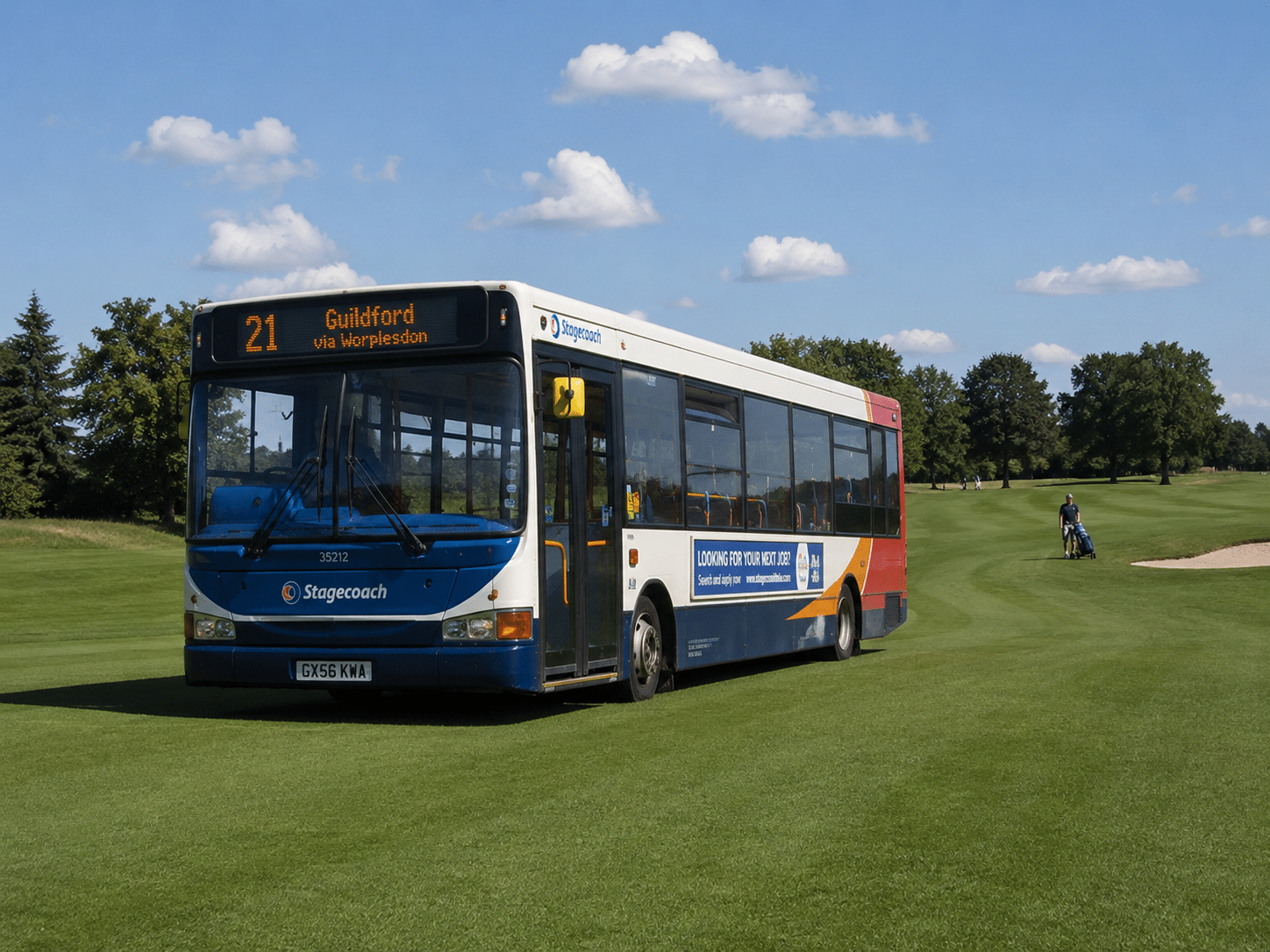
A couple of weeks ago, I watched a minor traffic incident on a narrow street — a city bus clipped a parked car’s mirror, nothing serious, no one hurt, just a small dent and a few minutes of paperwork. What stuck with me wasn’t the incident itself. It was the driver. He pulled over, calmly exchanged information with the other party, and within a couple of minutes, the bus pulled away and continued its route. No visible frustration, no lingering, no narrating the injustice of it to the next passenger who got on. Just: this happened, it’s logged, we’re moving again.
I couldn’t stop thinking about that driver a few days later, on a golf course, watching a much smaller disruption produce a much bigger reaction.
Frank three-putts the 4th green and you can see it happen in real time: shoulders drop, jaw tightens, a sharp exhale through the nose. By the 5th tee he’s still narrating the three-putt to anyone who’ll listen, and his drive goes sideways into the trees. “I just can’t shake it,” he says, as if the three-putt were a wasp that followed him to the next tee box. It didn’t follow him. He brought it.
Here’s the question that bus driver left me with: would he have handled Frank’s three-putt the same way he handled a dented mirror?
A city bus driver deals with dozens of small disruptions a shift — a passenger who’s rude, a red light that costs two minutes, a fender-bender that needs five minutes of paperwork. None of it derails the route. The driver doesn’t pull over to process how unfair the delay was. He absorbs it, handles what needs handling, and keeps driving, because the disruption is simply the cost of doing business. Nobody expects a bus route with zero disruptions. The job is to keep moving despite them, not to be surprised that they exist.
Golf has its own version of dented mirrors, and they happen constantly: a bad bounce, a three-putt, a partner who plays slowly, a gust that catches your ball mid-flight. None of these are personal. None of them are unusual. They are simply the route. And yet most amateurs respond to them the way an angry driver might respond to being personally wronged — with indignation — rather than the way a professional responds to the job itself: this is what the job is, keep driving.
The distinction matters because of what happens physiologically and mentally after a setback. A three-putt that gets treated as an injustice triggers rumination — replaying it, narrating it, defending yourself against it in your head — and rumination borrows attention from the only thing that actually helps the next shot: being present for it. A three-putt treated as a dented mirror, an ordinary cost of playing eighteen holes, gets logged and released in roughly the time it takes to walk to the next tee.
This isn’t about suppressing frustration or pretending you don’t care. That bus driver wasn’t emotionless; a dented mirror still registers as unpleasant, still costs him time he didn’t plan for. The skill isn’t the absence of a reaction. It’s the brevity of it. Notice it, handle what needs handling, get back to driving. The alternative — treating every bad bounce as a referendum on your game, your swing, your day — turns one bad shot into a chain reaction, because the frustration from shot one borrows the attention shot two needed.
Frank’s problem on the 5th tee wasn’t his swing mechanics. It was that he was still litigating the three-putt from two holes ago while a driver was in his hands. His nervous system had decided the three-putt was an injustice worth defending against, and that decision used up exactly the bandwidth his actual swing needed.
There’s a simple practical version of this you can try. After a bad shot, give yourself a brief, deliberately short window to react — a breath, a muttered word, whatever’s honest — and then a clear mental cue that closes the window: “Cost of doing business,” or simply, “Next stop.” The phrase matters less than the function: it’s a deliberate signal that the disruption has been logged and the route continues. You’re not pretending the three-putt didn’t happen. You’re refusing to let it ride along for the next nine holes.
Frank will probably never adopt this. He likes being the kind of golfer who’s still talking about a bad break on the 18th green, because to him, the talking feels like caring about the game. It isn’t. It’s just a longer way to arrive at the same score. That bus still had to finish its route either way. The only choice is whether you spend the ride between stops driving, or arguing with a dented mirror that’s already been logged and paid for.