
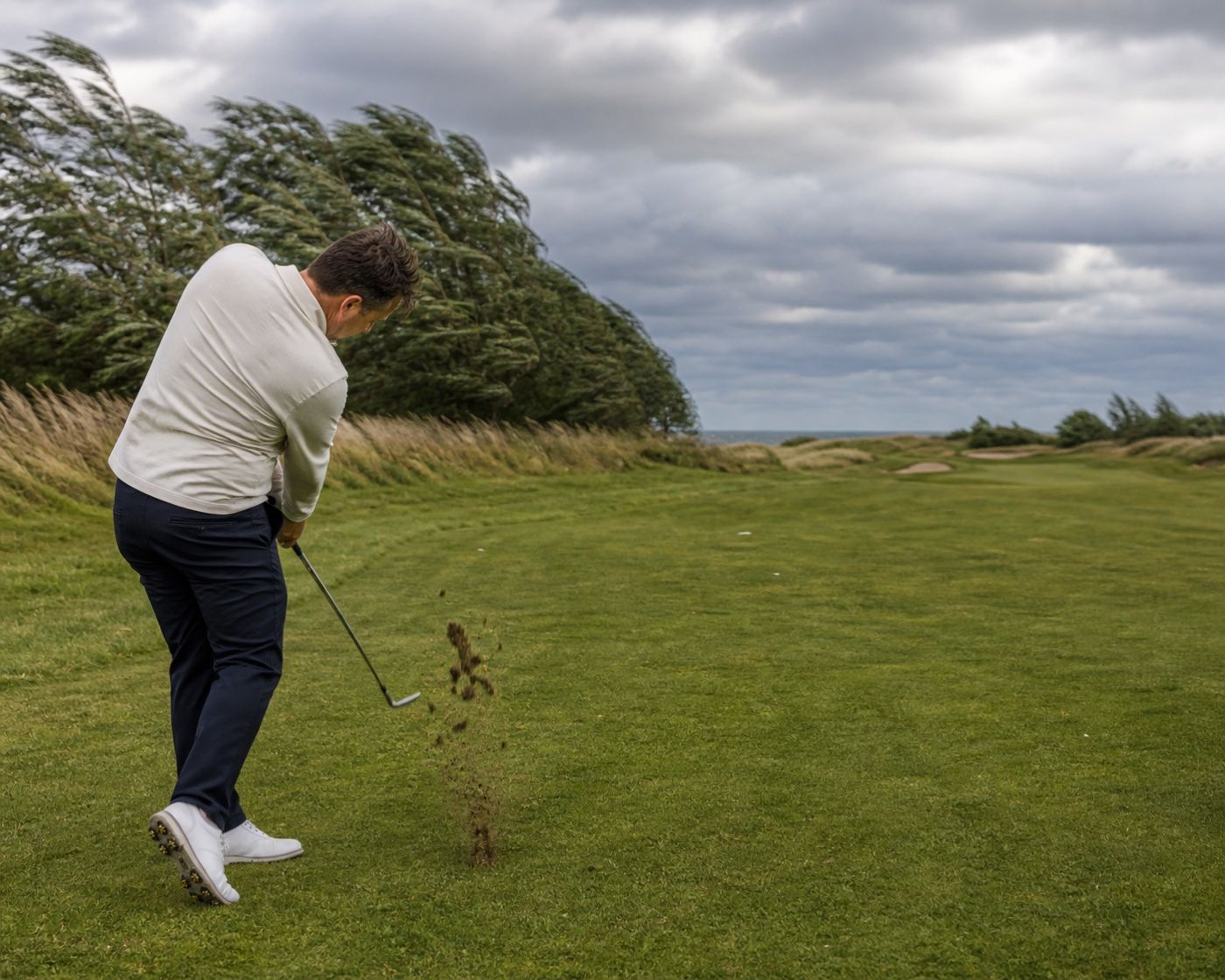
There’s a specific kind of confidence Frank carries onto a windy tee box. He’s done the math — fifteen miles an hour into the wind, take two more clubs, maybe three if it’s really howling — and he stands over the ball like a man who has solved the problem. He has solved one problem. It’s not the only one.
Ask most golfers what wind does and they’ll describe a distance adjustment: into the wind, the ball comes up short; downwind, it flies long; club up, club down, done. That’s true, but it’s the smaller effect. The bigger one is what wind does to dispersion — the width of the pattern your shots actually land in, not just the length of it.
A golf ball in flight spends more time exposed to crosswind the higher and longer its trajectory, and higher-spin shots — which describes most amateur iron and higher-lofted wood shots — curve more in wind than lower-spin ones, because spin is exactly what makes a ball responsive to air movement in the first place. TrackMan University’s wind research, built from thousands of tracked shots in real conditions, shows that crosswind doesn’t just push a ball sideways in a straight line the way people picture it. It amplifies whatever shot shape was already there. A golfer’s normal 8-yard fade in still air can turn into a considerably wider slide in a stiff crosswind, because the wind has more time to act on a ball that’s already curving, not less.
That means your dispersion pattern on a calm day and your dispersion pattern in a 15-20 mph crosswind aren’t the same shape — the windy one is wider, sometimes dramatically so, and it’s wider in the direction your ball shape already leans. Frank adjusts his club for the headwind and aims at the same target he’d pick on a calm day, effectively planning for his still-air miss pattern in conditions that have already widened it. He’s correct about the yardage and wrong about the shape of his own dispersion, which is the part that actually decides whether the ball ends up on the green or in the native grass forty feet right of it.
The practical fix isn’t complicated, it’s just unfamiliar: in real wind, the smart play usually isn’t a bigger swing at the same target, it’s the same swing at a safer one — aiming further from trouble on the side your shot shape favors, accepting a longer look at the pin in exchange for a dispersion pattern that’s already stacked against you. Ask any experienced caddie what changes most in a strong crosswind and it’s rarely just club selection. It’s where the target line moves.
Frank hit two clubs extra into a 175-yard par 3 with a two-club wind last month, aimed dead at a pin cut six paces from a front bunker, and found the bunker. Steve, hitting the same shot with a more conservative line toward the fat part of the green, made a routine two-putt par. Frank called it bad luck. It was the same wind acting on the same shot shape he always hits — just with more room to work.
Source: TrackMan University wind-effect research on ball flight and shot dispersion in crosswind conditions.