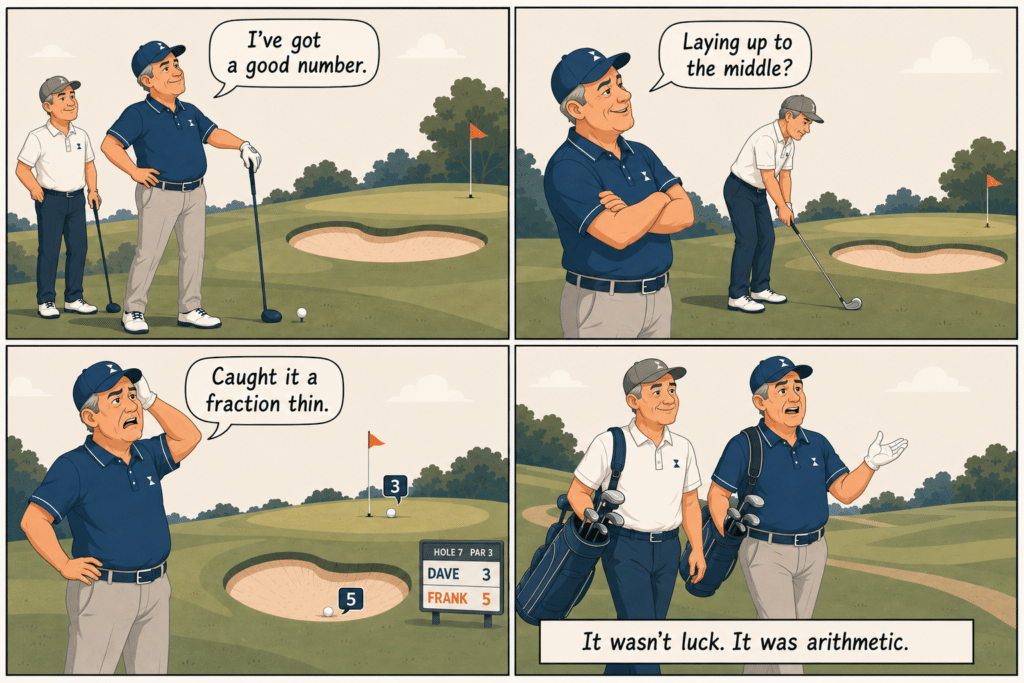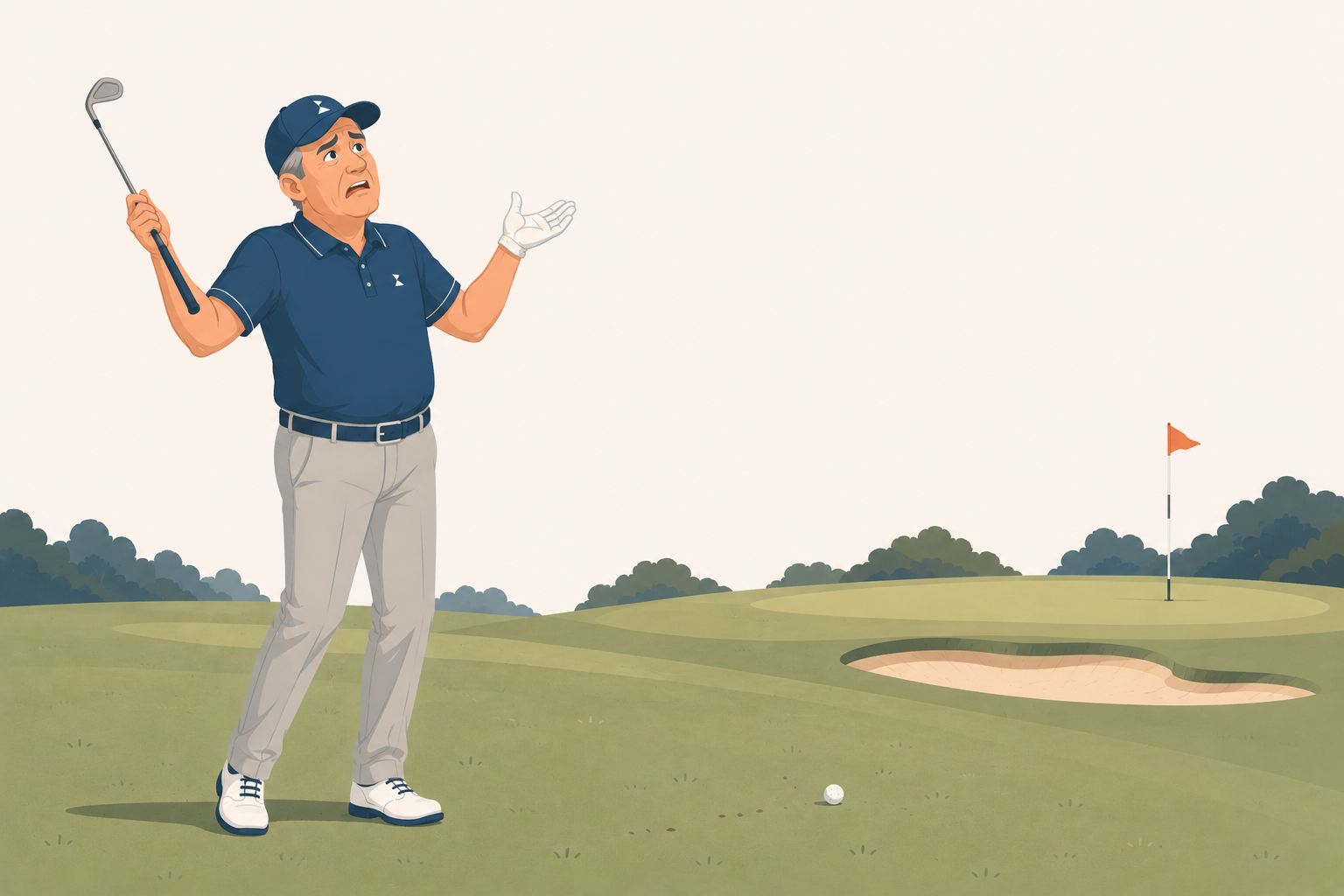
Frank stands in the 12th fairway, 160 yards out, pin tucked behind a bunker. He flushes it. Pure strike, exactly the number — and the ball finishes twenty feet right of the flag. Frank scowls like he’s been robbed. “Terrible shot,” he mutters. It wasn’t. That shot was completely normal. The only thing wrong was Frank’s idea of what “normal” should look like.
This is the single most expensive misunderstanding in amateur golf: the belief that good players hit the ball where they aim. They don’t. Nobody does. Not Frank, not you, not Scottie Scheffler.
Every shot you hit doesn’t land on a point — it lands somewhere inside a scatter pattern. A cloud of possible outcomes around your target. Hit a hundred seven-irons at the same flag and you’d get an oval-shaped spray of results, wider than it is deep, never a neat little pile on the pin. That cloud has a name: dispersion. And learning to think in clouds instead of points is what separates golfers who score from golfers who just hit shots.
Here’s the part that should change how you watch golf forever. The pros aren’t immune to this — they’re just playing the odds better than you are. Look at the actual numbers from tour-level players:
From 160 yards, only about 1% of tour shots finish within 3 feet of the hole. Only 5% finish within 6 feet.
From 115 yards — wedge distance, the scoring zone — tour pros miss the green entirely about one time in five.
And from 10 feet on the green, the best putters on earth make somewhere between 40 and 43% of their putts. They miss the majority.
Read those again. These are the best players in the world, and they are missing constantly. The difference is that they expect to. They don’t aim at flags and rage when they finish twenty feet away. They aim at the spot that gives them the lowest expected score given their dispersion — and they accept the scatter as the cost of doing business.
Frank does the opposite. He aims at the pin because the pin is where the hero shot lives. When the ball finishes where it was always statistically likely to finish — a bit right, a bit long — he treats it as a failure of execution. It wasn’t. It was a failure of expectation. His swing did its job. His planning didn’t.
This is why “play better” is usually the wrong goal. You don’t need to tighten your dispersion to shoot lower scores — that takes years, if it happens at all. You need to aim your dispersion more intelligently. Same swing, same scatter, smarter target. A golfer who accepts an imperfect cloud and aims it at the fat part of the green will quietly destroy a golfer with a tighter swing who keeps firing at sucker pins.
Golf isn’t a game of perfect shots. It’s a game of managed mistakes. The score doesn’t ask whether your shots were beautiful. It only counts them. And the player who plans for the miss — who treats the scatter as a fact to be managed rather than a flaw to be ashamed of — is the one walking off the 18th with the lower number.
Frank is still out there, by the way, flushing seven-irons and feeling cheated. The shots are fine. It’s the standard that’s broken.
Source: Strokes-gained and proximity statistics from Mark Broadie’s “Every Shot Counts” (2014), based on PGA Tour ShotLink data.