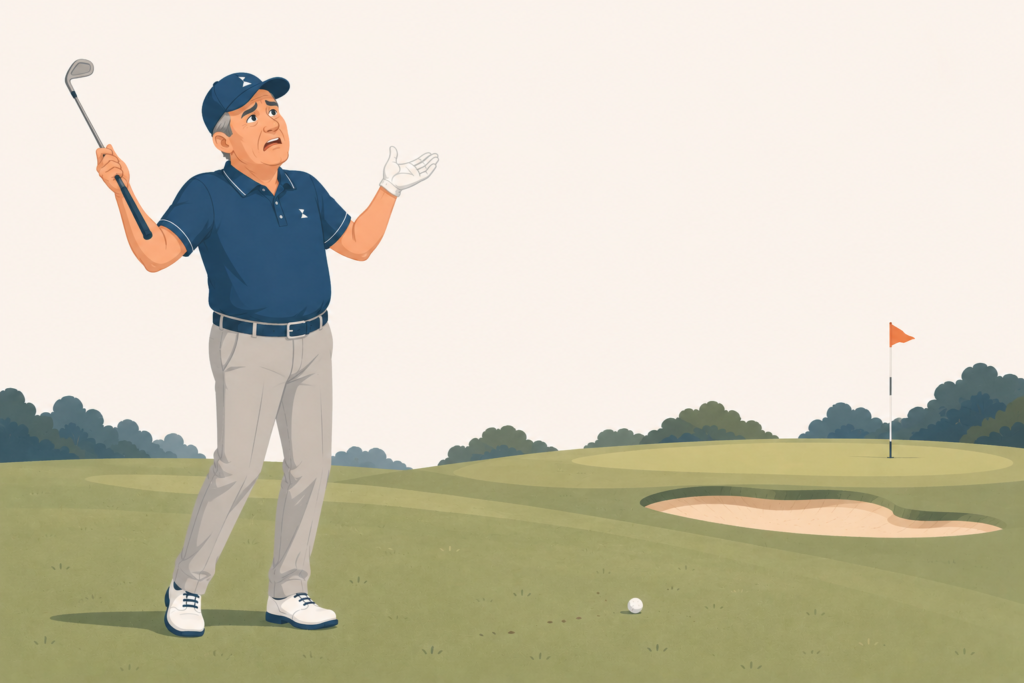
Frank stands over a 40-foot putt with the same intensity he’d bring to a 4-footer for the match. He reads the line from both sides, plumb-bobs his putter even though nobody’s seen him make a plumb-bob putt work in a decade, and strikes it like he’s trying to hole it. The ball races eight feet past, and now he’s got a putt back that’s longer than most approach shots. “I just wanted to give it a chance,” he says, as if a 40-footer were ever really about the hole. Two putts later, he’s still shaking his head.
Here’s the thing nobody tells Frank: from 40 feet, giving it a chance is the wrong goal. The right goal is finishing inside a circle, and the size of that circle matters more than the line.
Most golf instruction on putting focuses obsessively on the short, scoring putts — the 6-footers, the 10-footers, the ones with real pressure attached. That makes sense; those putts decide matches. But for most amateurs, the bigger and more consistent leak isn’t missing short putts. It’s the long ones that turn into three-putts because the first putt finishes six or eight feet away instead of two or three.
The fix has a name in better-player circles: the two-putt rule, or lag putting discipline. The idea is simple to state and uncomfortable to actually do: from outside roughly 25 to 30 feet, your only job on the first putt is distance control. Not the line, not the read, not “giving it a chance.” Just speed. If you finish within a tight radius of the hole — most good players aim for something like a 3-foot circle — the second putt becomes close to automatic, and your three-putts quietly disappear from the scorecard.
This requires a genuine mental shift, because it asks you to aim somewhere other than the hole on purpose. From 40 feet, the practical target isn’t the cup. It’s an imaginary circle around it. You’re not trying to make the putt; you’re trying to die it inside that circle, with enough speed to handle the break but not enough to race past. This feels like underachieving in the moment. It is, in fact, the opposite — it’s the version of the putt that actually protects your score.
A useful way to practice this: instead of practicing 6-footers over and over, which is what most range time on the green looks like, find three distances — say 20, 40, and 60 feet — and putt to a tee or a small towel instead of a hole. The absence of a hole removes the temptation to ram it at a target; all you’re doing is training your hands and eyes to judge speed across varying distances. Most amateurs have never practiced this in their life, despite three-putts being one of the most common, most preventable scoring leaks in recreational golf.
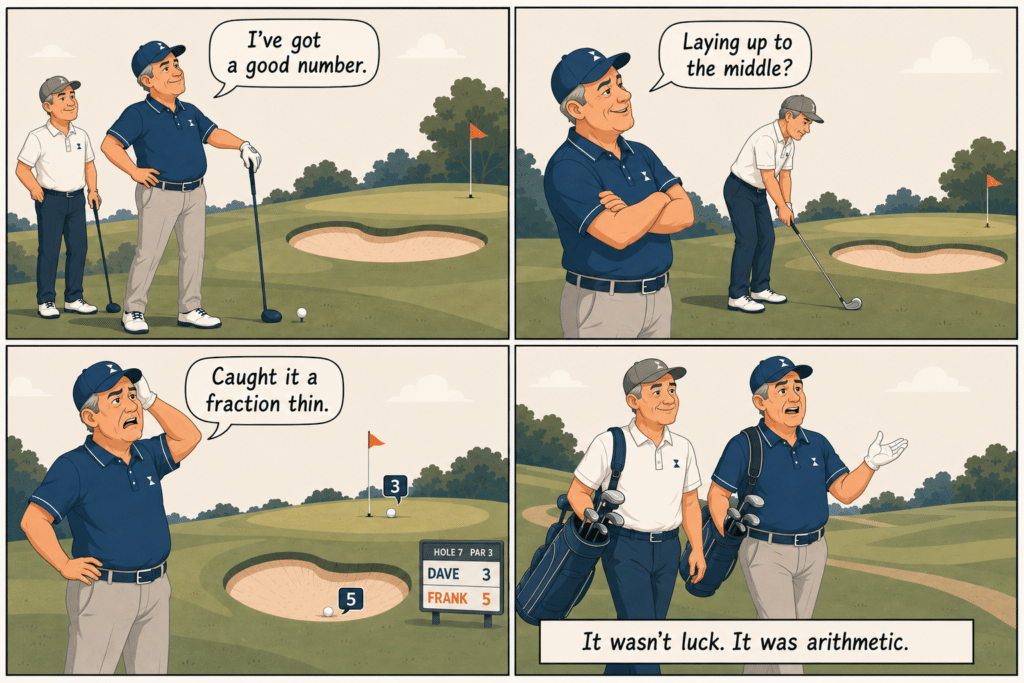
There’s a deeper principle hiding in here that connects to everything else GolfRealist talks about: a long putt is, structurally, the same problem as a tee shot at a flag tucked behind a bunker. The hole is bait. The smart target is the safe zone around it. The player who accepts “close” as a genuine, sufficient goal from long range will out-score the player chasing makes from every distance, every time, over a full season.
Frank will keep racing his 40-footers at the hole, because to him, lagging up feels like giving up. It isn’t. It’s the only version of that putt that doesn’t cost him an extra stroke he didn’t need to spend.
Source: Three-putt statistics by handicap level and PGA Tour lag-putting benchmarks reported by Back 2 Basics Golf and Shot Scope, based on shot-tracking data (Arccos, Shot Scope).