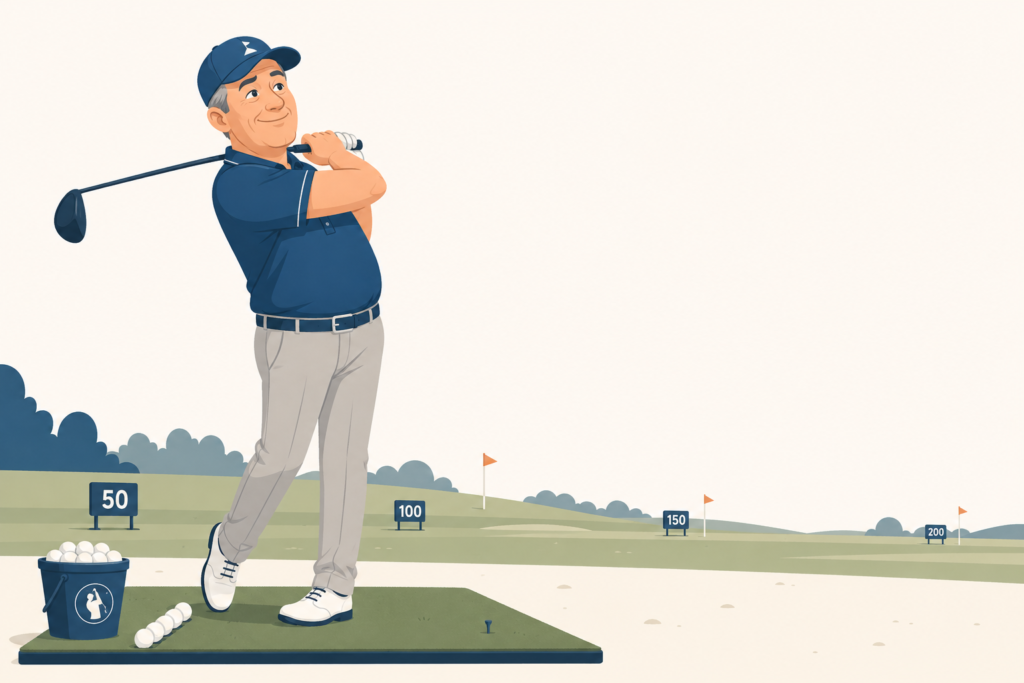
Frank has discovered the golf simulator. All winter he’s been going to the indoor golf place near his office — climate-controlled, a glass of something nearby, his swing data on a big screen telling him his clubhead speed is up and his smash factor is “tour level.” He’s striped it all winter. So when the season opens and he shoots his usual number, he’s genuinely confused. “I played great all winter,” he says. He did. On the screen.
Here’s the thing the golf simulator never shows you: there’s nothing at stake. And it turns out that nothing-at-stake is doing more of the work than Frank realizes.
Nassim Taleb has a phrase for this — “skin in the game.” His argument, in brief, is that systems behave completely differently depending on whether the decision-maker bears the consequences of being wrong. A pilot who flies the plane behaves differently from a consultant who advises on flying. Knowledge gained without consequences is a different, weaker thing than knowledge forged with them. And golf, it turns out, is a near-perfect illustration.
On a golf simulator, every golf shot is consequence-free in the deepest possible sense. Not just “there’s another ball” like on the range — but the ball never even has to exist in the real world. Miss it badly and the screen simply resets. There’s no out-of-bounds that costs you a stroke and a ball, no water you have to stand next to and stare into, no group waiting behind you, no card in your pocket with a number on it that you’ll have to sign for and remember. The simulator measures your swing. It cannot measure your golf, because golf is what happens when the swing has to survive contact with consequences.
This is why the transfer is so poor, and why it surprises people more than the range-to-course gap does. A simulator feels more “real” than the range — you’re playing actual holes, seeing actual yardages, getting actual data. So the disappointment when it doesn’t transfer is sharper. But realism of graphics is not realism of stakes. The screen can render Pebble Beach in 4K and still not put a single thing on the line.
There’s a second, subtler problem. Because the simulator gives you so much data — speed, launch, spin, carry — it quietly retrains your attention onto the wrong target. You start optimizing for the numbers the machine rewards, because those numbers are right there, glowing, measurable, improvable. But the course doesn’t reward smash factor. It rewards getting a ball from tee to hole in few strokes while managing fear, bad lies, and your own nervous system. The simulator can make you better at the simulator. That’s not the same as making you better at golf, and the precision of the data makes the illusion more convincing, not less.
None of this makes the simulator worthless. It’s genuinely useful for two things: making a specific mechanical change in a controlled setting, and keeping your body moving through a winter when the alternative is not swinging a club at all. As a maintenance tool and a lab, it’s fine. The error is the same one Frank always makes — mistaking the lab for the world, mistaking the measurement for the thing being measured.
The deeper point, and the one worth carrying past golf: any skill you build in a consequence-free environment is, to some degree, a fair-weather skill. It works until something is on the line, and then you find out how much of it was real. The only way to build the kind of golf that survives the first tee with people watching is to practice somewhere that the misses actually cost you something. The screen will always tell you what you want to hear, because the screen has no skin in the game. You do.
Frank will be back at the simulator next winter, smashing it, smash factor glowing tour-level on the screen. And next spring he’ll be confused again. The machine isn’t lying to him, exactly. It’s just answering a question he isn’t actually asking.
Source: The “skin in the game” concept draws on Nassim Nicholas Taleb’s “Skin in the Game” (2018).