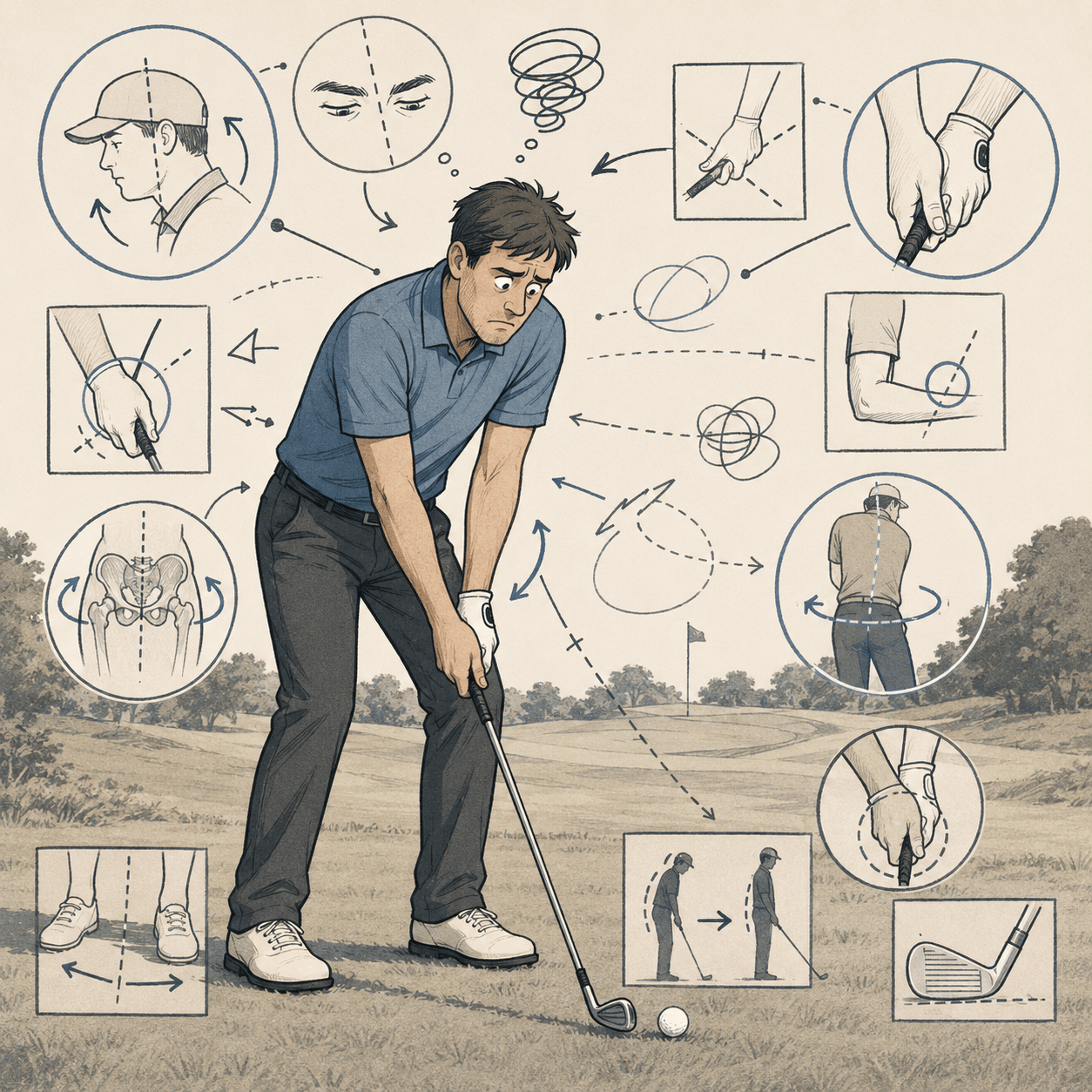
A bad shot has a strange effect on golfers. It makes them intelligent.
One thin iron and suddenly you become a biomechanics expert. Your left wrist was too cupped. Your hips stopped. Your head moved. Your trail elbow escaped. By the time you reach the next ball, you have four instructions and one swing.
This feels responsible. It is usually the beginning of the real problem.
A golf swing is too fast for a committee
A skilled movement is not assembled piece by piece during execution. It is organised by systems that work faster than conscious verbal control. You can use explicit instructions while learning or changing a movement. But once the shot matters, trying to supervise every component can interfere with the coordination you already possess.
Pressure makes this temptation stronger. A golfer who does not trust the outcome tries to control the movement. More control creates more tension and slower, less natural coordination. The poor result then appears to prove that even more control is needed.
That is the trap.
The issue is not that every swing thought is bad. A simple cue can be useful. The issue is the number, timing and type of thoughts you carry into execution.
“Smooth” is one cue.
“Keep the head still, turn the shoulders, shallow the club and clear the hips” is a meeting.
The range hides the problem
Technical thoughts often appear successful on the range because the environment is forgiving. You have another ball. The lie stays the same. The target does not move. Corrections from the previous attempt remain in short-term memory.
On the course, you get one attempt from a new lie with a consequence attached. The thought that helped you find a position on ball number 17 may not help you hit a target on the first try.
This is another version of the GolfRealist distinction: range performance is not automatically golf skill.
Separate learning from playing
Use two modes.
Learning mode belongs in a lesson or a deliberate technical block. Work on one change, use feedback, and repeat enough to understand the task.
Playing mode begins when you test transfer. Choose a target, imagine the shot, make one rehearsal if needed, and react to an external task. Change club and target after every ball. Keep the technical cue minimal—or remove it completely.
On the course, the decision should be finished before you address the ball. Once you step in, your job is not to repair your swing. Your job is to send the ball toward a target.
The one-cue rule
If you need a cue, choose one that is short and stable. Rhythm words often work better than a list of body parts. So can an external intention such as starting the ball through a window or brushing the grass beyond the ball.
Then test it honestly:
- Does it survive a change of club?
- Does it survive a poor lie?
- Does it survive one-ball practice?
- Can you use it without becoming more tense?
- Does it improve the pattern, not merely one shot?
If not, it may be a range solution rather than a golf solution.
The GolfRealist rule
Diagnose patterns after the round. Do not rebuild the machine between shots.
A bad swing does not always require a swing fix. Sometimes it requires a wider target, a safer club, a reset, or the acceptance that golf contains bad shots.
The player who thinks less is not necessarily careless. He may simply have done his thinking at the correct time.
Source: Masters, R. S. W. (1992), “Knowledge, knerves and know-how: The role of explicit versus implicit knowledge in the breakdown of a complex motor skill under pressure.”